
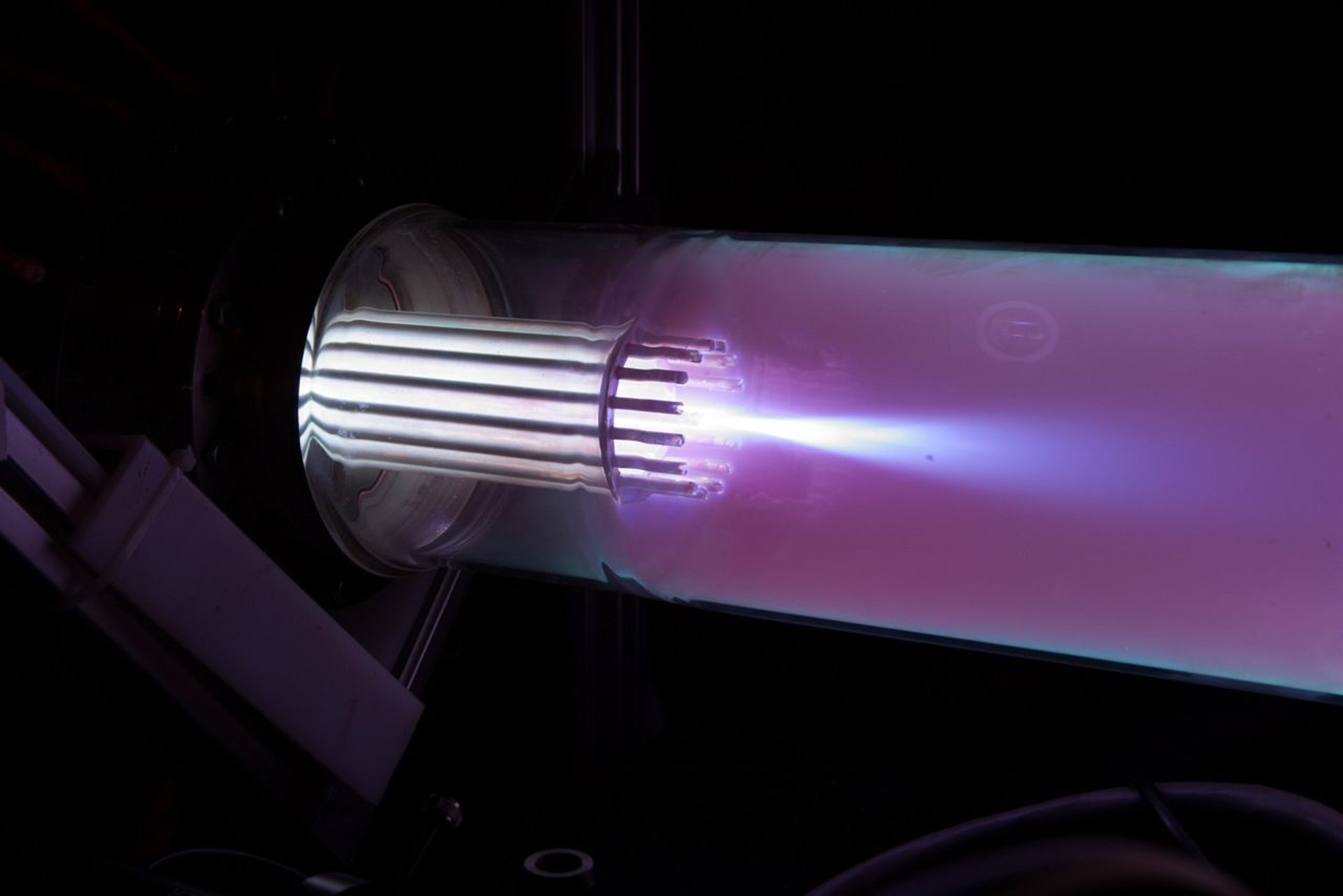
PLASMA THRUSTER
A plasma thruster is a device that accelerates ionized gas to produce thrust, typically by depositing electrical energy into a propellant to generate a high-velocity exhaust. Historically, these systems have been used on satellites for precision attitude control and station-keeping, where their small impulse bits and long operational lifetimes are critical. As the technology evolves, plasma-based micro-propulsion is becoming a candidate for agile small-satellite maneuvering, distributed constellations, formation flight, and eventually as a modular building block for higher-power pulsed propulsion concepts with applications in future space mobility.
Background credits: © Stanford Plasma Physics Laboratory
PLASMA THRUSTER
Experimental Project
Experimental Project
A plasma thruster is a device that accelerates ionized gas to produce thrust, typically by depositing electrical energy into a propellant to generate a high-velocity exhaust. Historically, these systems have been used on satellites for precision attitude control and station-keeping, where their small impulse bits and long operational lifetimes are critical. As the technology evolves, plasma-based micro-propulsion is becoming a candidate for agile small-satellite maneuvering, distributed constellations, formation flight, and eventually as a modular building block for higher-power pulsed propulsion concepts with applications in future space mobility.

The project
We are developing a mini pulsed plasma–thermal thruster capable of delivering measurable impulse bits through rapid energy deposition, gas expansion and controlled plasma generation. Our goal is to produce a fully characterized prototype that links modeling, fabrication and experimentation within a single coherent system, demonstrating how low-cost hardware can be used to explore real plasma-propulsion physics. We aim to generate reliable performance data, validate simplified models, and show that accessible laboratory setups can reveal meaningful insights about unsteady plasma–gas coupling.
The outcome
We aim to deliver a fully documented, experimentally validated plasma-propulsion demonstrator, and showcase ENSAM’s aerospace research capabilities on the national stage. The project positions our team within a field that carries major potential for the future of space mobility, offering a modest yet inventive contribution to ongoing advances in pulsed and micro-propulsion technologies. Beyond the technical results, we want to demystify experimental plasma physics for students, proving that with ingenuity and limited resources, it is possible to design, build and test a real thruster and engage directly with the scientific process.

Our support
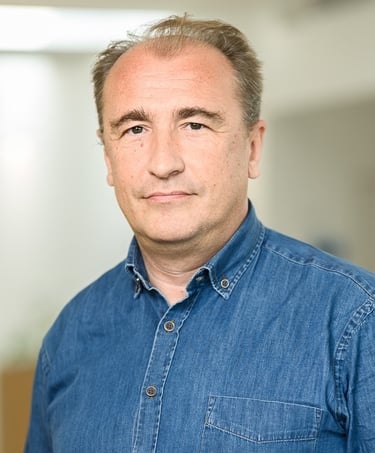
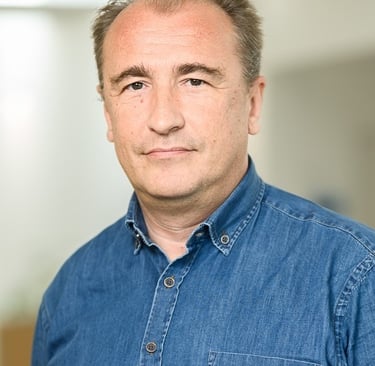
Prof. Bruno Fayolle, P.I.





The stages: where do we currently stand?
Phase 1 — Theory, Models & Architecture - done
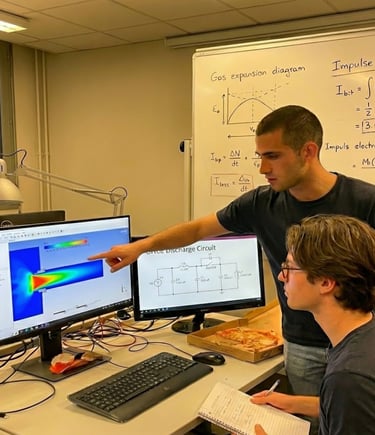
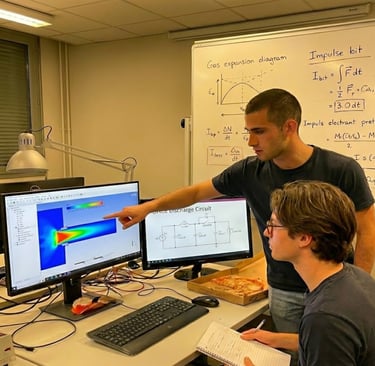
We began by building the full analytical backbone of the thruster. We developed a 0D energy model estimating the pulse energy deposited into the gas (0.2–1.5 J), a SPICE circuit model of the discharge chain (bank capacitance, ESR, stray inductances), and a set of geometry constraints linking chamber volume, electrode gap (1 mm baseline), and nozzle throat diameters (1.2 / 1.5 / 2.0 mm). We then produced a first set of CFD configurations in OpenFOAM for both air and argon, exploring impulsive heating over ~100 µs and its effect on plume Mach number, expansion angle, and relaxation time. All model files, notebooks, and figures were deposited in our Git repository at the end of November, forming the theoretical foundation for the entire project.
Phase 2 — CAD, CFD & Electrothermal Modeling - done
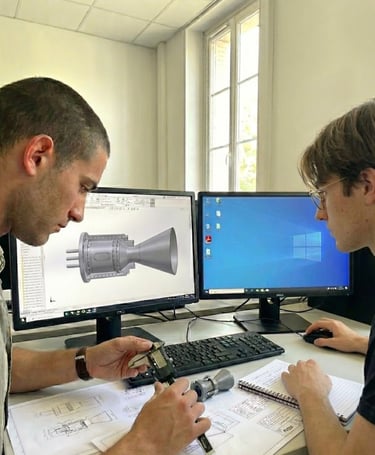
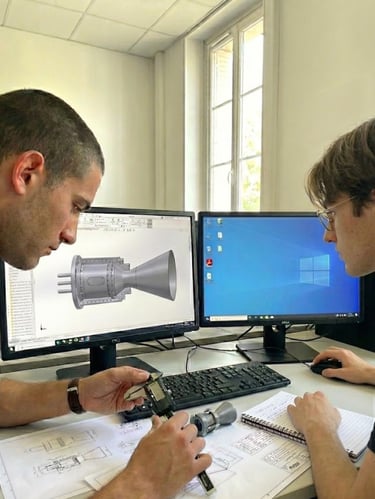
We translated the analytical work into a fully defined mechanical architecture. The chamber support was modeled in aluminum with a ceramic liner, the tungsten cathode and copper anode were dimensioned precisely, and three interchangeable nozzles (1.2 / 1.5 / 2.0 mm throats) were designed for testing. We ran transient CFD simulations for single pulses and pulse trains in air and argon, validating key physical behaviors: over-expansion, pressure decay, and the dependence of impulse on throat diameter and injected energy. An electrothermal model in COMSOL provided maps of electric field concentration near the 1 mm electrode gap and predicted local heating zones. By December 31st, we had a complete manufacturable design package, a library of processed CFD runs, and a preprint summarizing all theoretical and numerical results.
Phase 3 — Procurement, Fabrication & Assembly - in process
In January and February, we moved to hardware. We purchased and received all materials: tungsten electrodes, polypropylene capacitors rated for ≥2 kV, PTFE and mica insulation, Swagelok fittings, argon supply hardware, and all structural elements. At PIMM lab, we machined the aluminum chamber support to a ±0.05 mm tolerance, fabricated the three nozzles, and produced the adjustable electrode mounts. We are now assembling the full mechanical system at LIFSE lab, fixing the ceramic chamber, aligning the electrodes to within 0.1–0.2 mm, integrating thermocouples and a piezo sensor, building the gas line (0–3 bar), and installing the HV components inside a dedicated Faraday cage. By late december, we aim for the bench to be fully constructed, instrumented, leak-tested, and electrically validated with multiple dry-fire tests.
Phase 4 — Integration, Calibration & System Validation - in process
We are now completing the full operational integration of the thruster. We are mounting the final cage enclosure in polycarbonate, calibrating all sensors (load cell, HV probe, thermocouples), synchronizing our acquisition pipeline, and validating the interaction between gas injection, high-voltage pulsing, and structural dynamics. Over the next weeks, we will carry out cold-flow tests, low-energy dry-fire tests, and combined gas+pulse tests to secure LIFSE approval for ignition. By the end of March, our goal is to certify the entire bench—mechanically, electrically, and fluidically—and obtain the official GO for plasma experimentation.
Phase 5 — Experimental Characterization - upcoming
We will perform a full experimental campaign consisting of single-pulse characterizations, frequency sweeps up to 100–150 Hz, and a Design-of-Experiments exploration across nozzle geometries, gas pressures, and pulse energies. We will quantify impulse bit, average thrust, Isp, efficiency, plume dynamics, and thermal behavior, and we will record high-speed video, acoustic signatures, and electrode degradation. All data will be consolidated into a reproducible dataset.
Phase 6 — Analysis, Modeling Correlation & Publication - upcoming
We will process the entire dataset, extract performance metrics, and compare them rigorously against our 0D, SPICE, and CFD predictions. We will produce publication-grade figures, analyze discrepancies between models and experiments, and write a complete research paper suitable for HAL/arXiv and conference submission. The final output will be a fully documented, reproducible micro-propulsion research project.

contact@amspace.fr
+33 650345244
Contact Us
Follow us
151 Boulevard de l'Hôpital, 75013 Paris, France